What ports are on each MacBook?
The port configuration of Apple's notebook series is constantly updated with the iteration of new products, and there is both inheritance and innovation between models. Understanding the differences between these ports can help users better choose the appropriate expansion devices and external solutions.
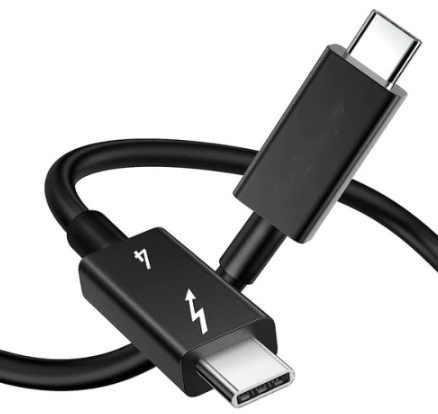
Among Apple's recent notebook products, the M1/M2/M3 MacBook Air and 14-inch M3 MacBook Pro are equipped with two ports designated by Apple as "Thunderbolt / USB 4"; while the newer 13-inch and 15-inch M4 MacBook Air and Pro models are equipped with two Thunderbolt 4 ports. The 14-inch and 16-inch M1/M2/M3 Pro, the regular M4 MacBook Pro, and the M1/M2/M3 Max MacBook Pro models are all equipped with three Thunderbolt 4 (TB4) ports. Apple's dual designation of non-pure Thunderbolt 4 ports does not need to be too concerned. Except for the limit on the number of external monitors, it has little impact on most users.
Apple's latest M4 Pro and Max MacBook Pro models are the first to be equipped with three Thunderbolt 5 ports. Thunderbolt 5 has strong compatibility and is backward compatible with TB4, TB3 and USB-C devices. Although Thunderbolt 5 devices and docks are relatively rare in the market, it has a data transfer rate of 80Gbps and a video rate of 120Gbps, which has great development potential. Before Thunderbolt 5 technology is popularized and the dock market matures, the 40Gbps Thunderbolt 4 dock is still a practical choice.
Looking back at the development history of Apple notebook ports, the old 12-inch MacBook is only equipped with one 5Gbps Gen 1 USB-C port. The Intel MacBook Air from 2018 and later, and the MacBook Pro from 2016 onwards, have two or four 40Gbps Thunderbolt 3 ports, which have significantly improved data transmission and external connection capabilities compared to previous generations.
MacBook Air and Pro built-in ports listed
13-inch and 15-inch M1/M2/M3 MacBook Air: Two Thunderbolt/USB4 ports and one MagSafe 3 charging port, plus headphone jack
13-inch and 15-inch M4 MacBook Air: Two Thunderbolt 4 ports and one MagSafe 3 charging port, plus headphone jack
13-inch M1/M2 MacBook Pro: Two Thunderbolt/USB4 ports and one MagSafe 3 charging port, plus headphone jack
14-inch M3 MacBook Pro: Two Thunderbolt/USB4 ports, one HDMI port, one SDXC card slot, plus headphone jack
14-inch M1/M2/M3 Pro, M1/M2/M3 Max and plain M4 MacBook Pro: Three Thunderbolt 4 (USB-C) ports, one HDMI port, one SDXC card slot, plus headphone jack
14-inch M4 Pro or M4 Max MacBook Pro: Three Thunderbolt 5 (USB-C) ports, one HDMI port, one SDXC card slot, plus headphone jack
16-inch M1/M2/M3 Pro or M1/M2/M3 Max MacBook Pro: Three Thunderbolt 4 (USB-C) ports, one HDMI port, one SDXC card slot, plus headphone jack
16-inch M4 Pro or M4 Max MacBook Pro: Three Thunderbolt 5 (USB-C) ports, one HDMI port, one SDXC card slot, plus headphone jack
How many external displays can each MacBook support without a dock?
M1/M2: One external display with up to 6K resolution at 60Hz.
M3: Two external displays, one with up to 6K resolution at 60Hz and one at 5K/60Hz when the MacBook lid is closed.
M4: Two external displays, one with up to 6K resolution at 60Hz and one at 5K/60Hz.
M1/M2/M3/M4 Pro: Up to two external displays with up to 6K resolution at 60Hz over Thunderbolt, or one external display with up to 6K resolution at 60Hz over Thunderbolt and one external display with up to 4K resolution at 144Hz over HDMI. Or one external display supported at 8K resolution at 60Hz or one external display at 4K resolution at 240Hz over HDMI.
M1/M2/M3/M4 Max: Up to four external displays: Up to three external displays with 6K resolution at 60Hz over Thunderbolt and one external display with up to 4K resolution at 144Hz over HDMI. Up to three external displays: Up to two external displays with 6K resolution at 60Hz over Thunderbolt and one external display with up to 8K resolution at 60Hz or one external display with 4K resolution at 240Hz over HDMI.
Apple's M-series silicon gives MacBooks powerful performance, making them significantly faster than Intel processor models. However, performance is not completely proportional to the ability to support external displays, and there are significant differences between different MacBook models in terms of external displays.
MacBooks equipped with regular (non-Pro or Max) M1 and M2 chips have a surprising limitation - they cannot support multiple external displays in extended mode, even through the Thunderbolt port. Users can only choose dual mirrored displays or connect only one external display. Although the regular M3 MacBook has improved and can support two displays, it is necessary to close the lid to use it. However, with the help of third-party DisplayLink or InstantView software, and with a dedicated USB-C docking station, M1, M2, and M3 MacBook users can break through the native limitations and achieve multi-display expansion.
It is gratifying that the more powerful M1/M2/M3 "Pro", M1/M2/M3 "Max" MacBook Pro models, as well as the regular M4 MacBook, have excellent display support and can natively support multiple displays. Among them, the Max MacBook Pro, with a docking station, can drive up to four 6K displays to meet the multi-screen work needs of professional users.
In terms of display resolution support, although some docking stations claim to support 8K displays, the Mac only supports a maximum of 6K resolution when connected through the docking station. For Macs equipped with M2/M3/M4 Pro or Max chips, if you want to connect to an 8K display with a 60Hz refresh rate, you need to use the Mac's built-in HDMI port, which cannot be achieved through the docking station.